
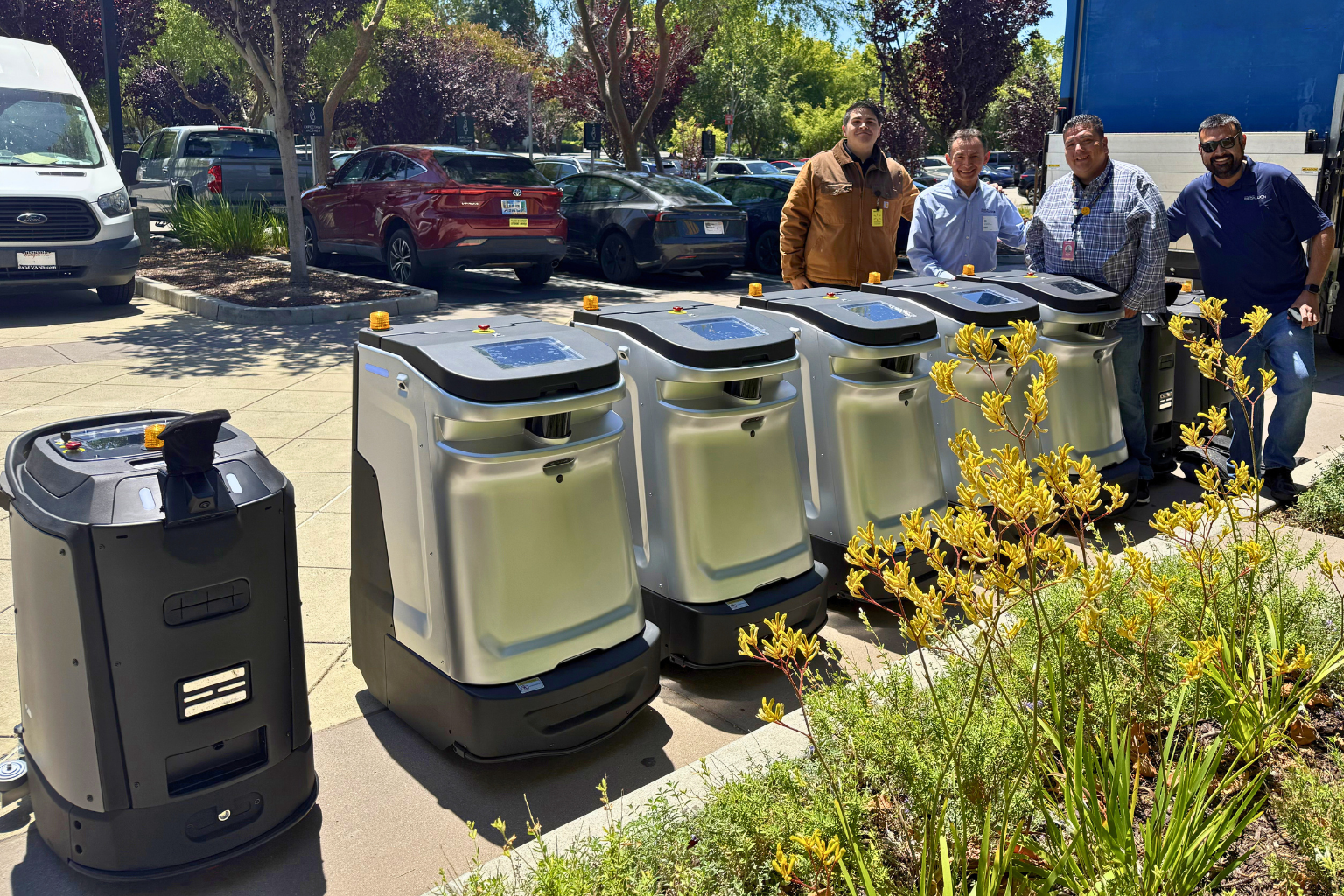
Cleaning Robots Aren’t Changing Cleaning. They’re Changing Contracts.
Elias Nacif, Executive Vice President, Service by Medallion
I keep hearing the same questions about cleaning robots.
Will they replace cleaners? How many labor hours will they save? What’s the ROI? Can a robot really clean as well as a person?
They are fair questions. But after enough conversations with facility leaders, procurement teams, and cleaning professionals, I have become convinced that we are studying the wrong thing.
We are focusing on the robot, while the real story is standing right beside it.
The person who once spent several hours walking behind a floor scrubber can now deploy an autonomous machine and turn their attention to edges and corners, entrances, glass, tenant requests, and the detail work that requires human judgment.
The three hours of floor care have not disappeared. The floor is still being cleaned. But during those same three hours, the cleaning professional can produce additional work.
For the first time, one shift can create two simultaneous streams of productivity: one from the person and another from the machine.
That does more than change how cleaning gets done. It challenges how cleaning services are defined, measured, and purchased.
Robotic floor cleaning has crossed from emerging technology to a mainstream operational tool. If robotics is becoming standard, the real conversation shifts from the machines themselves to how cleaning programs are measured, managed, and purchased.
ISSA, March 2026
We Have Trained Clients to Buy Cleaning by the Hour
For decades, commercial cleaning programs have been built around inputs: square footage, frequencies, staffing levels, labor hours, supervision, and scope.
Those inputs are tangible. They make programs easier to price, compare, and manage. Over time, however, labor also became a proxy for service.
More people must mean more cleaning. Fewer hours must mean less cleaning.
The cleaning industry helped create that assumption. We conditioned clients to equate visible labor with value, often documenting every scheduled hour and staffing position as proof that the program was adequately resourced.
Robotics begins to break that equation.
When part of the nightly production can happen without someone physically pushing a machine, headcount alone no longer tells the full story. Labor hours still matter, but they are no longer the only source of cleaning production.
That changes the question from: How many hours can we eliminate?
To: What can we accomplish with those same hours now?
The greatest return may not come from removing labor at all. It may come from redirecting human capacity toward the work that repeatedly falls outside a traditional scope: detail cleaning, high-touch areas, faster response times, safer work with less repetitive strain, and more attention to the occupant experience.
If we evaluate robotics only by the labor it removes, we miss much of the value it can create.
Buying a Robot Is Not the Same as Creating an Outcome
Of course, none of that additional value appears simply because a machine arrives at the building.
This is where the robotics conversation often becomes too easy. A robot is purchased, a route is programmed, and the technology is declared “deployed.”
But rolling a machine onto a floor is not implementation. It is the beginning of implementation.
Robots do not simply get deployed. They get integrated, optimized, and validated.
Robotics Separates Labor from Production
This is the real shift.
Robotics is not valuable simply because a machine may replace several hours of repetitive work. It is valuable because it begins to separate labor hours from cleaning production.
Once that happens, staffing levels can no longer serve as the primary measure of what a cleaning program is capable of delivering.
Facility leaders should continue asking about cost, performance, implementation, and ROI. But the conversation should not stop at how much labor a robot can remove.
The more valuable question is:
What can the cleaning program deliver now that it could not deliver before?
And that question has a larger implication.
If cleaning production is no longer tied directly to labor hours, should labor hours remain the primary way we define, price, and evaluate the service?
Robotics may automate floor cleaning. Its bigger impact is forcing our industry to reconsider what a cleaning contract is actually buying.
Next in the series: If labor hours no longer prove that the work happened, what does?