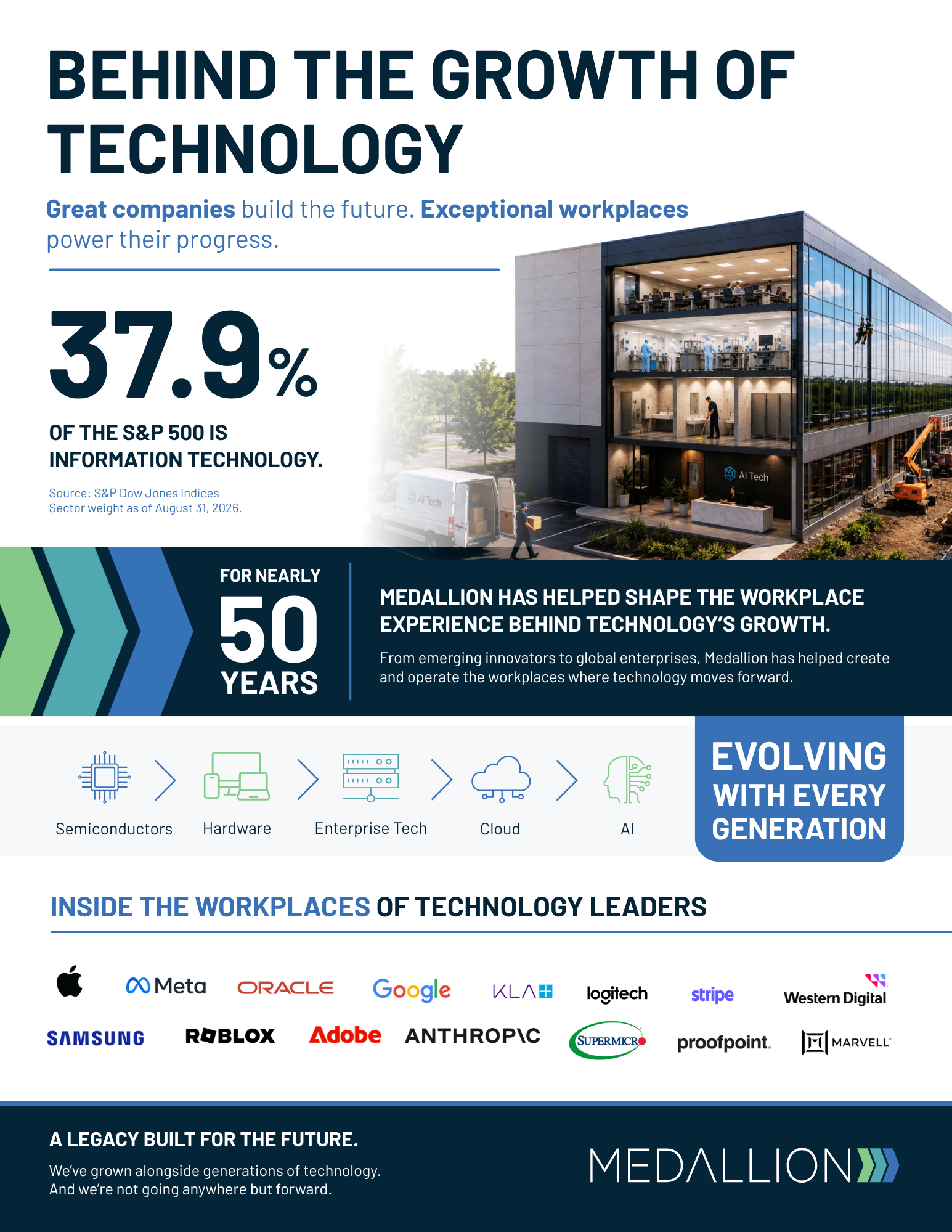
How Service by Medallion has helped technology companies grow through every era of innovation.
Hypergrowth doesn’t come with a predictable roadmap.
For nearly 50 years, Service by Medallion has supported technology companies through some of their most significant periods of growth. From organizations like Atari and Oracle during earlier waves of technology expansion to today’s cloud, software, and AI innovators, we’ve seen a consistent pattern emerge: growth creates operational challenges long before most organizations are prepared for them.
Headcount increases. New offices come online. Services expand. Priorities shift. What worked six months ago suddenly no longer scales.
Today’s growth cycle is being fueled in large part by AI. In Q1 2026, technology companies accounted for nearly 23% of all U.S. office leasing activity, while AI-related demand continues to drive expansion across major markets. Since 2020, U.S.-based AI companies have also attracted $578 billion in venture capital as organizations race to build the next generation of technology.
But regardless of the technology driving growth, workplace and facilities leaders face the same challenge: preparing for expansion without creating unnecessary complexity, overhead, or operational risk.
One recent client engagement illustrates what that looks like in practice.
A Modern Example of Hypergrowth
Service by Medallion began supporting approximately 240,000 square feet across the client’s technology portfolio. The initial scope included maintenance, facilities project support, health and safety, janitorial, and specialty cleaning.
Within six months, the footprint more than doubled, extending into major metropolitan areas across the United States. The next phase is expected to bring Medallion’s scope to nearly four times its original size, with additional U.S. locations projected through 2027.
Within just six months, the scope more than doubled, extending into major metropolitan areas across the United States.
Each new location brought challenges beyond additional square footage. New teams had to be recruited. Additional locations and services had to be mobilized. Technology and processes had to support a more complex operation. At the same time, the established portfolio still needed consistent service and attention.
The challenge was not simply to add capacity. It was to absorb new responsibilities on aggressive timelines without creating disruption for the client or lowering standards across existing workplaces.

The Approach
Building Operational Capacity Before It Becomes Urgent
Every technology company follows a different path, but workplace leaders often encounter the same pressure points:
- New locations requiring support on short timelines
- Additional services being introduced as needs evolve
- Growing stakeholder groups with differing expectations
- Limited internal resources available to coordinate everything
Addressing those pressures takes more than staffing individual buildings. It takes an operating model that can adjust as locations, services, and priorities change.
Planning Ahead
Rather than focusing solely on immediate requests, Medallion worked to understand where the client was headed and what resources, services, and operational capabilities would likely be needed next.
That preparation allowed the team to respond to changing requirements without treating each new request as an isolated event.
Mobilizing Quickly
As new needs emerged, personnel were recruited and deployed accordingly.
When an accelerated timeline required a new workplace to be prepared for occupancy, Medallion completed the mobilization in just over two weeks.
Speed mattered, but consistency mattered just as much.
Each new location had to align with established workplace expectations while integrating into the broader operating model.
Expanding Capabilities
As requirements changed, Medallion’s responsibilities expanded beyond janitorial services to include facility services, mailroom operations, facility technicians, and shipping and receiving.
Instead of adding disconnected vendors to address each new need, the client was able to broaden services through Medallion’s existing operational framework.
Maintaining Standards
Growth places pressure on service quality, responsiveness, communication, and operational visibility.
Processes and technologies were introduced to help manage increasing complexity while ensuring workplace standards remained consistent across locations.
The objective was straightforward: support changing business needs without increasing friction for employees or stakeholders.
The Results
Operational growth means little if performance declines along the way.
While the portfolio and service scope continued to increase, Medallion maintained:
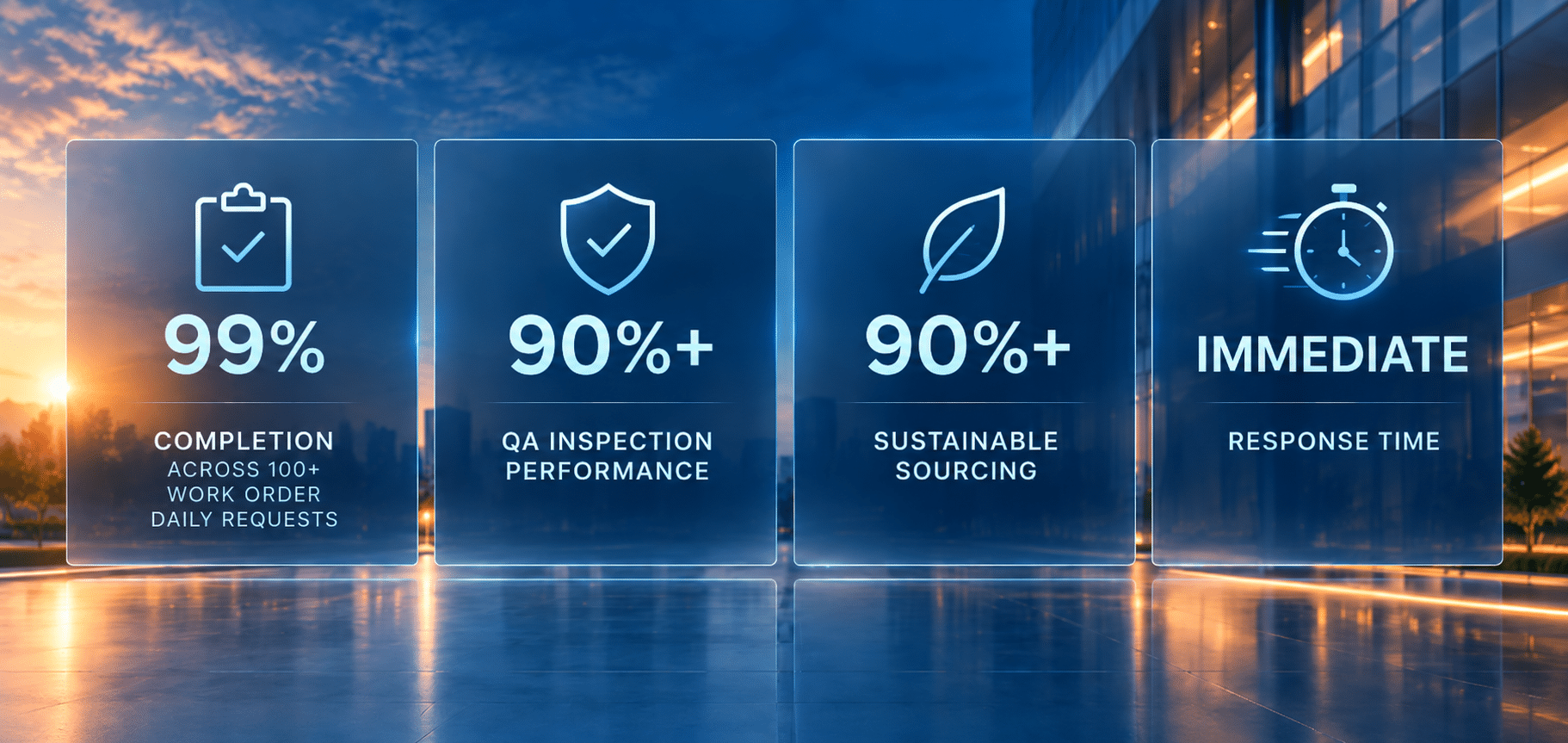
The outcome was an operation capable of supporting new locations, additional stakeholders, and expanded responsibilities while maintaining service expectations.
Most importantly, the client continued entrusting Medallion with additional responsibilities as needs evolved.
Trust is often the clearest indicator of performance. Organizations do not broaden a provider’s role during periods of change unless they are confident in its ability to execute.

What Technology Companies Should Look for in a Facilities Partner
Few organizations will experience the same trajectory as the world’s fastest-growing technology companies.
That doesn’t mean they won’t face the same operational challenges.
When evaluating a facilities partner, workplace leaders should ask:
Can they mobilize quickly?
New locations and changing requirements rarely arrive on a predictable schedule.
Can they support multiple service lines?
Today’s needs may look very different from tomorrow’s.
Can they maintain performance during periods of change?
Expansion often tests operational discipline more than routine operations do.
Can they help reduce complexity?
A facilities provider should simplify workplace operations, not create another layer to manage.
Can they adapt as business priorities change?
The provider should be able to adjust staffing, services, and operating plans without forcing the client to rebuild the model each time priorities shift.
The strongest facilities partners are not simply built for today’s requirements. They are structured to adapt as organizations evolve.
Built to Support What’s Next
Technology will continue to change.
The companies shaping the next decade may be advancing artificial intelligence, robotics, advanced manufacturing, life sciences, or innovations that have yet to emerge.
The workplaces, facilities, and operating models that support those organizations may look very different from those we know today. What remains constant is the need for infrastructure that can adapt as business requirements change and new ways of working emerge.
For nearly 50 years, Service by Medallion has helped organizations navigate those transitions. As technology reshapes how work gets done, our role is to help clients build the operational foundation behind what comes next.
Let’s grow together